Subtropical Gulf Coast conditions create an environment where mound-building insects reproduce without a true winter dormancy. The heavy clay soils of Meyerland, Oak Forest, and West University Place retain moisture…
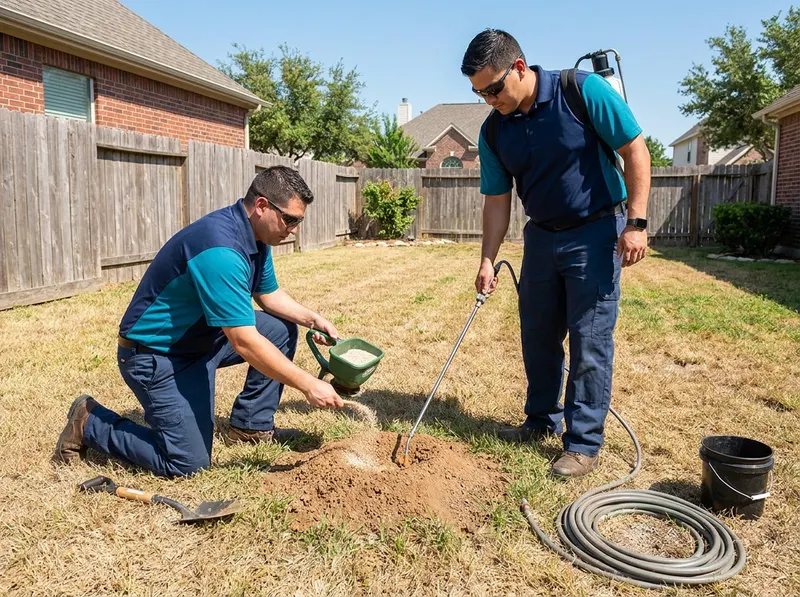
Subtropical Gulf Coast conditions create an environment where mound-building insects reproduce without a true winter dormancy. The heavy clay soils of Meyerland, Oak Forest, and West University Place retain moisture following downpours, driving red imported fire ants to build visible mounds in turfgrass, while sandy loam zones in Kingwood encourage extensive subterranean foraging networks. Eliminating these pests requires targeting the queen rather than simply scattering surface workers.
When contact sprays strike a mound, colonies frequently activate a survival reflex known as budding, splitting into multiple satellite colonies under sidewalks, patio slabs, and turf edges. Professional remediation relies on non-repellent transfer baits and precision injection tools that worker ants carry directly into deep nesting chambers, neutralizing the reproductive queen within several days.
Dense tree canopies and mature hardwoods throughout River Oaks, Memorial, and Montrose present a distinct risk profile for wood-destroying carpenter ants and moisture-loving rover ants.
Overhanging live oaks and pine branches touch rooflines, providing arboreal bridges that allow foraging trails to enter fascia boards, weep holes, and wall cavities without making ground contact. gov/">Texas Department of Agriculture to protect sensitive landscaping and building envelopes. gov/">United States Environmental Protection Agency.
The decision between spot mound remediation and a comprehensive perimeter barrier depends on property acreage and surrounding moisture pressures. For a standard 5,000-square-foot lot in The Heights or Clear Lake, spot-treating visible mounds resolves localized stinging hazards, but fails to prevent subterranean reinvasion from neighboring easements or park borders. A continuous perimeter barrier combined with slow-acting granular insect growth regulators establishes a 60-to-90-day protective envelope around the foundation.
org/">International Association of Certified Home Inspectors.
Treatments follow a three-step implementation sequence: First, technicians inspect soil lines, expansion joints, air-conditioning pads, and landscape beds to map active foraging trails. org/">Better Business Bureau.
Third, a protective micro-barrier is placed 3 feet up the exterior slab and 5 feet out onto turf to intercept wandering workers. ZephyrShield Exterminators delivers this systematic defense across Houston, providing reliable relief from stinging lawn pests. Contact (107) 407-7064 for details, with $25 off a same-day evaluation booking.
Every job gets a firm, written price after a free on-site visit.
For standards, safe disposal, and service guidance on pest control services in Houston, TX, useful references include U.S. EPA, ENERGY STAR, U.S. Dept. of Energy, Consumer.gov, U.S. Census Bureau, and Google Maps. General consumer and small-business resources are available from USA.gov, Better Business Bureau, FTC Consumer Advice, U.S. Small Business Administration, and Ready.gov.
Tell us about your ant colony and mound control job in Houston and we'll send a clear, written quote, usually the same day.
 ZephyrShield Exterminators