Stinging insect populations along the Texas Upper Gulf Coast peak between April and October, when ambient humidity levels recorded by the National Weather Service Houston/Galveston regularly exceed 80%, accelerating…
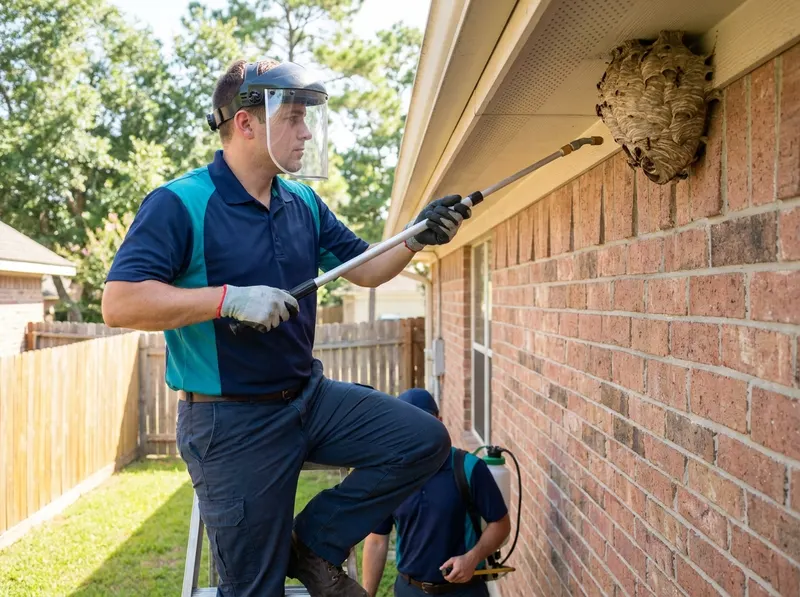
Stinging insect populations along the Texas Upper Gulf Coast peak between April and October, when ambient humidity levels recorded by the National Weather Service Houston/Galveston regularly exceed 80%, accelerating breeding cycles. Paper wasps and yellow jackets frequently exploit structural transitions on Houston properties, building aerial hives beneath soffits in The Heights and Montrose or nesting within the dense boxwood hedges of River Oaks and West University Place. Over-the-counter pyrethroid sprays frequently scatter aggressive colonies into nearby window weep holes or through soffit vents into attic spaces rather than eliminating the core brood. ZephyrShield Exterminators applies a clinical physical barrier protocol, utilizing specialized micro-injectors that apply botanical-derived pyrethrins evaluated under EPA pesticide regulations directly into the central comb structure, dropping foraging workers instantly without distributing airborne toxins throughout living areas.
Subterranean yellow jackets present distinct mechanical challenges near waterways such as Buffalo Bayou and Brays Bayou, where saturated soils in Memorial and Meyerland force queens to construct nests inside discarded rodent burrows, tree hollows, or landscape timber cavities. A single ground nest can shelter 1,500 to 4,000 workers by late summer. Our technicians inspect the nesting aperture using thermal imaging, apply calibrated insecticidal dust formulation conforming to safety guidelines from the Occupational Safety and Health Administration, and physically excavate the underground combs to stop scavenging pests from colonizing residual pupae. For tree-canopy infestations in wooded areas like Kingwood and Oak Forest, pole-mounted injection equipment reaches heights up to 24 feet without requiring structural ladder placement against delicate stucco or exterior finishes, aligning with biological management practices supported by the Texas A&M Department of Entomology.
Following physical nest detachment, technicians scrape residual anchoring pedicels down to the structural substrate and treat the surface with a hydrophobic barrier formulation. This residual layer breaks the territorial pheromone matrix identified by the Entomological Society of America that otherwise signals fertile queens to establish replacement colonies in the identical framing notch. Structural exclusions cover gaps along roof flashing, chimney caps, and brick weep holes using brass mesh recommended by the Texas Department of Agriculture for urban pest containment. Moisture-prone soffits and patio ceilings receive preventative repellent applications that withstand Gulf Coast downpours, supported by research from the Pest Control Technology Association on subtropical pesticide degradation rates.
1. Initial perimeter inspection: The technician conducts a 360-degree perimeter assessment around foundations, fascia boards, and attic gables to identify all active nests, satellite foraging corridors, and high-risk entry voids.
2. Protective knockdown and isolation: Technicians clad in full sting-rated canvas suits inject localized, fast-acting flushing agents directly into the brood chambers, intercepting guard wasps before perimeter alarm pheromones trigger colony dispersal.
3. Complete physical extraction: Hives, comb fragments, and dead insect biomass are mechanically removed, sealed into heavy-gauge containers, and transported off-site, preventing secondary beetle infestations monitored by the Texas A&M AgriLife Extension.
4. Void treatment and barrier installation: Technicians apply long-lasting desiccating silica dust through attic vents and seal structural openings according to standards outlined by the National Pest Management Association, followed by protective barrier misting around outdoor living areas verified via the Texas Parks and Wildlife Department non-target wildlife guidelines.
Every job gets a firm, written price after a free on-site visit.
For standards, safe disposal, and service guidance on pest control services in Houston, TX, useful references include U.S. EPA, ENERGY STAR, U.S. Dept. of Energy, Consumer.gov, U.S. Census Bureau, and Google Maps. General consumer and small-business resources are available from USA.gov, Better Business Bureau, FTC Consumer Advice, U.S. Small Business Administration, and Ready.gov.
Tell us about your stinging insect and wasp nest removal job in Houston and we'll send a clear, written quote, usually the same day.
 ZephyrShield Exterminators