Rodent activity in Harris County accelerates under specific regional climate dynamics. The subtropical climate documented by the National Weather Service Houston/Galveston Office drives rodents indoors as seasonal…
Rodent activity in Harris County accelerates under specific regional climate dynamics. The subtropical climate documented by the National Weather Service Houston/Galveston Office drives rodents indoors as seasonal downpours raise bayou water levels across Buffalo Bayou Park and Brays Bayou. In residential neighborhoods such as The Heights, Montrose, and Oak Forest, historic crawlspaces and pier-and-beam foundations allow Norway rats ground-level access, while dense live oak canopies in River Oaks and Memorial provide roof rats direct pathways to soffit returns and ridge vents. Standard retail rodenticides fail to provide structural remediation because baiting leaves rodents to perish within inaccessible wall voids, producing biohazard contamination. Rodent biology guidelines outlined by the Texas A&M Department of Entomology demonstrate that permanent abatement requires mechanical structural modification rather than consumable poisons.
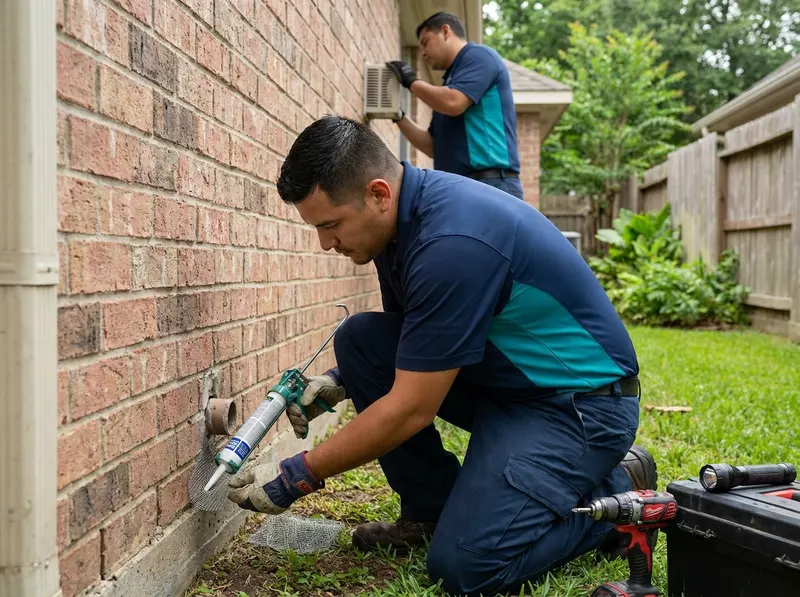
Effective defense relies on material durability. Norway rats exert gnawing pressures exceeding 7,000 pounds per square inch, easily penetrating construction-grade expanding foams, standard timber, and plastic vent screens. The Centers for Disease Control and Prevention advises sealing every opening measuring 0.25 inches or wider with heavy-gauge materials. ZephyrShield Exterminators installs 19-gauge hot-dipped galvanized hardware cloth and elastomeric sealants conforming to ASTM International building performance standards across weep holes, attic vents, and plumbing penetrations. In modern construction across West University Place and Meyerland, exterior brick weep holes require specialty steel inserts that block rodent transit while preserving interior cavity drainage verified under structural principles from the Insurance Institute for Business & Home Safety. Properties near coastal drainages in Clear Lake or forested parcels in Kingwood experience heightened pressure along utility chase lines, requiring copper mesh packing beneath non-shrink exterior masonry mortars.
The operational sequence executes in three distinct phases. First, mechanical snap traps and multi-catch sensors are positioned along confirmed interior transit rub marks within attics and basements; secondary poison baits are restricted indoors to protect non-target household pets in compliance with EPA Rodenticide Safety Standards. Second, exterior exclusion workers seal structural gaps along roof transitions, eaves, and foundation footings. Third, biological remediation sanitizes contaminated insulation materials. The Texas Department of State Health Services identifies murine typhus and hantavirus as chronic risks associated with accumulated rat droppings. Contaminated substrate is misted with hospital-grade botanical disinfectants certified by the NSF International public health framework and vacuumed using high-efficiency containment equipment compliant with OSHA Respiratory Protection Standards. Homeowners can reach ZephyrShield Exterminators at (107) 407-7064 to schedule a preliminary structure assessment.
Every job gets a firm, written price after a free on-site visit.
For standards, safe disposal, and service guidance on pest control services in Houston, TX, useful references include U.S. EPA, ENERGY STAR, U.S. Dept. of Energy, Consumer.gov, U.S. Census Bureau, and Google Maps. General consumer and small-business resources are available from USA.gov, Better Business Bureau, FTC Consumer Advice, U.S. Small Business Administration, and Ready.gov.
Tell us about your rodent exclusion and removal job in Houston and we'll send a clear, written quote, usually the same day.
 ZephyrShield Exterminators